Read below or download the document here
The New Forest roadside verges are a rich habitat despite their low-key appearance. Just how rich is bring discovered by one of our Trustees, Clive Chatters, who is carrying out important verge surveys this summer, funded by the New Forest Biodiversity Forum. We look forward to the full results of his work. The introduction of car parking charges in all Forestry England (FE) Car Parks in the Forest on 20th April 2026 brought the risk of displacement parking onto Forest verges with visitors tempted to avoid paying parking charges.
The Natural England Assents[1] recognised this risk and only permitting FE to introduce car parking charges provided they take mitigation measures on FE managed land as well as attempt to minimise displacement parking on other parts of the Forest which are not managed by FE. These are largely the adjacent commons.
These mitigation measures include (inter alia): [2]
The NE Assent permitting roadside ditching and dragon’s teeth also calls for FE verge monitoring.[3]
The New Forest Association (NFA) with NFDOG decided to provide a further element to these measures by conducting a Verge Watch which commenced when car park charges were introduced and will continue until the end of August. Given that we are about halfway through this watch period, we felt it useful to report on the findings so far and before the tourist season gets into full swing. It is hoped this data will supplement FE’s own monitoring.
Members of the NFA and NFDOG were invited to report instances of verge parking by using a simple Microsoft designed form:
The results are thus based on voluntary reporting on a random basis. It is acknowledged that they are not a systematic survey of verge parking during this period but provide an impression of the scale of verge parking where volunteers have reported incidents.
The data has been collated and form the basis of this interim report.
Our preliminary observations are:
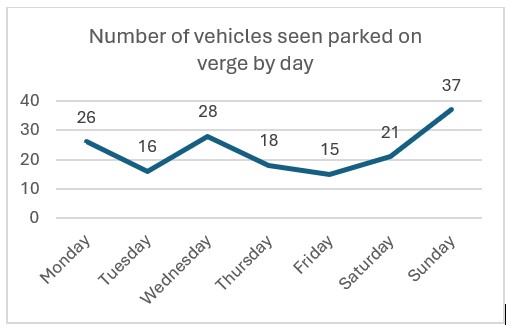
Observations were made on all days of the week. There is an increase on Sundays, but reports are made on every day of the week.
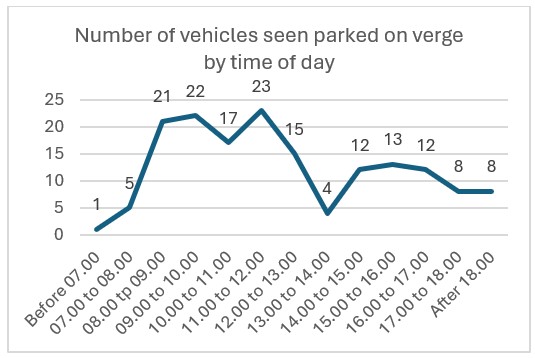
The peak time vehicles were seen parked on verge is between 8 and12 o’clock in the morning, with a sharp lull over lunch time and a smaller peak between 2 and 5 o’clock in the afternoon.
In the great majority of cases (114) volunteers saw a single vehicle parked on the verge, with a smaller number (24) seeing two vehicles. In three cases nine or more vehicles were seen at a single place. These were all at Balmer Lawn in Brockenhurst on Sundays or a Bank Holiday and reflected the fact that the nearby car parks at Balmer Lawn and Tillery Road were full.
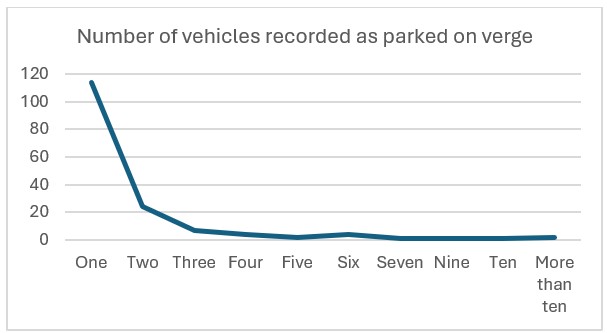
The form invited comments from recorders, and a number made useful observations. These included:
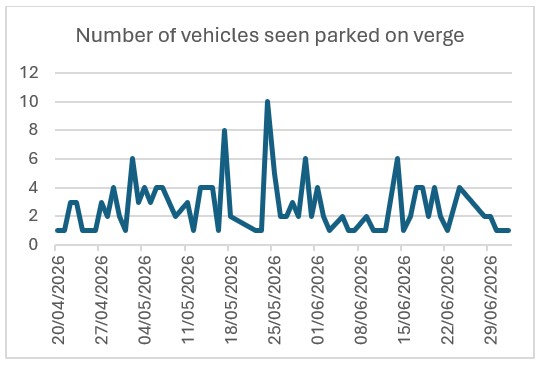
The scale of verge parking has not been as extensive as it might have been and the mitigation measures adopted by FE are welcome. They appear to have help keep the instances of verge parking low. Nevertheless, the recording of 160 incidents during the first two months of the introduction of charges is notably. The number of repeat offenders is particularly concerning. It is hoped that these repeat offenders can be discouraged by the actions of FE car park rangers. It causes frustration to those that do park responsibly, encourages others to park on verges and can lead to avoidable damage to the verges themselves. Continued parking in gateways is also concerning given their importance for continued access for emergency vehicles, commoners and forest operations.
The recommended measures to address parking on more than 2 occasions found at para 4.3 of the Footprint Ecology Habitat Regulation Assessment (2024) need to be applied.
It will be interesting to see what the high tourist season brings and how the verges fare. Unfortunately, the lack of rain has had an adverse impact on their condition and the recovery of habitat from the mitigation ditching work.
[1] Natural England Assents Nos 1509251021AS (27/10/25) and 1311250852CG (08/12/25).
[2] See Table 3 Footprint Ecology’s Habitat Regulation Assessment 2024.
[3] See Natural England Assent No 1509251021AS (27/10/25).
Registered charity no. 260328
New Forest Association © 2026
All rights reserved
All photographs ©
Photographs courtesy: Clive Chatters, Gale Pettifer, Steve Laycock, Mike Read, Brian Tarnoff, Peter Roberts, John Ward.