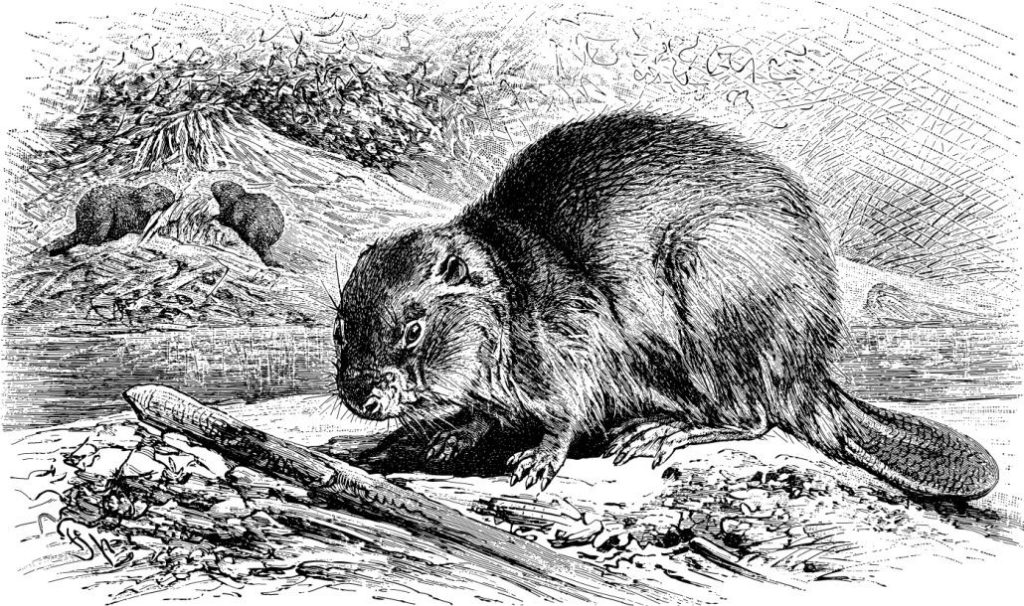
| This note records the outcome of discussions by the Habitats and Landscape Committee of the New Forest Association to consider the possible consequences of Beaver Castor fiber becoming established as a free-living animal in the New Forest National Park. The discussion has been assisted by guests, both attending committee and through informal discussions, and also by colleagues sitting on the New Forest Biodiversity Forum. It is important to note that there are currently a diverse range of views on the topic, including between individual ecologists, between institutions with management responsibilities, and amongst the wider public. The findings reported in this note are those of the Habitats and Landscape Committee.
The desired outcome of these discussions is to identify what, if any, additional information is required to assess the potential positive and negative effects of the establishment of free-living Beaver in the New Forest National Park, together with considering what institutional arrangements may be required to manage issues arising from the establishment of those Beavers. This note is structured to make general comments on Beaver, then to make general comments on the New Forest, followed by a consideration of possible interactions between the two. |
Beavers are a long-standing member of the fauna of western Europe dating back to at least the Pliocene – Early Pleistocene, some two million years ago. As such, for much of recent ecological history, ecosystems in what is now lowland England have evolved in the presence of Beaver. The mammal fauna, of which Beaver are a part, has varied greatly since the Pliocene with its diverse assemblages of herbivores and carnivores, most of which are now extinct.
There is no archaeological evidence from the current interglacial of Beaver in the New Forest. However, absence of evidence is not evidence of absence.
There is archaeological evidence of Beaver in the lower Test valley during the Bronze Age (Yalden 1999). The Test has tributaries rising in the Forest.
There are recent records of free-living Beaver in the Hampshire Avon, which has tributaries rising in the Forest.
Beavers have been subject to extensive research, in mainland Europe and elsewhere in the northern hemisphere. The literature relating to the North American Beaver Castor canadensis will assist the understanding of European Beaver Castor fiber.
There are predictable scenarios through which Beaver may arrive in the New Forest. These are regulated introductions, unregulated and unauthorised introductions, along with natural colonisation into the Forest from neighbouring introduced populations. The initial distribution of Beaver under the first two scenarios will be determined by people. Under all scenarios, once established, a population will establish a distribution of its own choosing, dependant on the suitability of available habitats.
There is national interest in the re-establishment of free-living Beaver in the wild. The case for Beavers as ‘ecosystem engineers’ in restoring the biodiversity and dynamism of impoverished wetland systems has been proven. There are rivers and wetland ecosystems within the New Forest National Park which are likely to benefit from re-colonisation by Beaver. These are watercourses which have been modified by historical drainage and current land use, including forestry and farming. However, the New Forest differs from much of lowland Britain in also retaining near-natural wetland systems of exceptional importance, and it is this circumstance which has been addressed by the Habitats and Landscape Committee.
The New Forest is a landscape where wetland complexes form part of a highly diverse suite of habitats of national and international importance. The natural dynamism of the New Forest is complemented by the grazing of commonable livestock which are the ecological successors of native large herbivores. The Forest’s wetland systems include entire catchments which are substantially unmodified by conventional agriculture, urban settlement and river engineering, and so represent as near-natural conditions as may be found in British lowland river systems.
Whilst relatively large in a contemporary context, the New Forest represents a fragmentary survivor of a much larger, interconnected suite of habitats, which dominated this part of central southern England as recently as the late eighteenth century. Whilst the Forest exhibits degrees of resilience unfamiliar in more fragmented landscapes, its isolation leaves it vulnerable to pressures, of internal and external origin.
The Forest’s wetlands are naturally dynamic with riparian features including springheads and seepages, ephemeral headwaters with surface and subsurface flows, seasonal anastomosing channels, abundant coarse woody debris (including dams), pool and riffle complexes, silt-beds, berms and backwaters. These dynamic features support a range of wetlands including extensive mire systems and seasonally flooded alluvial grasslands along with a range of riparian woodlands including seasonally inundated alluvial woodlands and permanently saturated bog woodlands and swamps. Standing-water habitats are predominantly ephemeral with a few permanent still waters of anthropogenic origin. Water quality across much of the Open Forest is exceptional and supports an outstanding assemblage of clean water habitats.
Forest wetlands are contiguous with the intertidal Solent and so there are gradations of habitats from the hypersaline and saline through a gamut of brackish conditions.
The nature and distribution of riparian and coastal habitats has changed within living memory in response to natural and anthropogenic forces.
The New Forest is host to internationally important assemblages of species. These assemblages are associated with the structural diversity and dynamism of Forest habitats. Noteworthy species include those which comprise the vegetation including communities dominated by vascular plants and bryophytes. Gladed woodlands are important for epiphytes, notably bryophytes and lichen along with fungi, vertebrates and invertebrates which live within and upon those trees and epiphytes. The Forest is also exceptional for its ephemeral wetland ecosystems, some of which are dependent on their isolation from permanent waterbodies.
The granularity of habitats and species surveys is varied. There is a reasonable understanding of the extent and distribution of the principal habitats along with some academic research on flow patterns and river dynamism. Single species and assemblage studies vary in detail. These are sufficient to identify their importance, but seldom sufficient to provide a base-line from which change may be measured.
From what is known of Beaver behaviour, the mammal may change the frequency, intensity and distribution of existing dynamic processes. The sole additional effect, currently absent in the Forest, is removal of trees and shrubs. The behaviour of Beaver has consistent elements which vary in detail depending on the nature of the habitats they occupy. It is not possible to be certain as to which aspects of their behaviour may be expressed in the Forest until they are in occupation.
Existing natural dynamism in Forest wetlands brings many environmental benefits along with actual and perceived conflicts. There are established management processes to address and resolve these issues on the Open Forest. The benefits of natural dynamism include providing natural flood defences along with the irrigation and fertilisation of floodplain lawns. Of particular contention is the perceived risk to human life and property from flooding, along with the unseasonal inundation of alluvial grasslands. The pattern of flooding and saturation is also an important factor in the management of recreational access to the Forest and is likely to become of increasing importance in strategic fire management. From what we know of Beaver behaviour, the establishment of these animals along Forest rivers could compound and intensify these issues. It is necessary to predict and plan for interactions between Beaver and other interests and to have structures in place to address issues in a timely fashion.
Two suites of habitats are currently considered to be at risk from some aspects of Beaver behaviour – these are old growth pasture woodlands of riverine corridors together with valley mires and related fen communities.
The felling of trees by Beaver is likely to affect assemblages of species which are attuned to the current pattern of tree growth, recruitment, death and regeneration. The old growth pasture woodlands of the New Forest are of national and international importance for a broad range of exacting species, including (but not exclusively) epiphytic lichen and bryophytes, saprophytic fungi, and saproxylic, corticolous and other invertebrate communities, together with invertebrates, vascular plants, fungi, and bryophytes of the woodland floor, and fish assemblages of wooded waterways.
Management measures used to influence Beaver behaviour elsewhere, are inimical to the conservation of the outstanding biodiversity of the Forest’s riparian woodlands.
The behaviour of Beaver in extensive mire systems is problematic to predict. Beaver behaviour has the potential to alter long-established flow patterns, upon which existing interests depend.
Similarly problematic is predicting the interactions between ephemeral waters (both in channel and out-of-channel ephemeral ponds) and Beaver behaviour which seeks to deepen water bodies.
Circumstances will differ between the enclosed landscapes of the National Park and the unenclosed commonable landscapes of the Open Forest.
There is a need to better understand the assemblages of species in different habitat types that are likely to be positively and negatively impacted by Beavers. This may be advanced through the allocation of species to guilds – reflecting Forest habitats – in a Forest-wide biodiversity audit. Such an audit is being progressed by the Biodiversity Forum.
There is a need to review literature addressing Beaver in habitats with broad similarities to those found in the Forest, given most reintroductions to date have occurred in highly degraded landscapes. Opportunities to undertake this review are being progressed by the Wildlife Trust.
There is a need to better understand the likely relationship of Beaver to the Forest’s pastoral economy along with its status as access land.
There is a need to better understand the opportunities and risks of Beaver populations to biodiversity, socio-economic interests, and potentially human life and property in the New Forest, and how risks have been managed in other catchments.
There is a need to establish trusted institutional arrangements to manage issues arising from beavers.
| Clive Chatters, Chair of Habitats and Landscapes Committee, New Forest Association, Charity No 260328 25th November 2024 |
Registered charity no. 260328
New Forest Association © 2026
All rights reserved
All photographs ©
Photographs courtesy: Clive Chatters, Gale Pettifer, Steve Laycock, Mike Read, Brian Tarnoff, Peter Roberts, John Ward.