With local government reorganisation imminent the Waterside is proving popular. Southampton City Council and Eastleigh Borough Council are casting envious eyes. The New Forest District Council are sending a robust hands-off message which Sir Julian Lewis, the New Forest East MP, is supporting. The NFA welcomes their opposition and are pleased to learn that residents are going to be able to express their opinion. [1]
The Waterside is very much part of the Forest- historically, geographically, environmentally and culturally. The National Park boundary includes the south of the Waterside and Natural England’s National Character delineation of the New Forest includes the Waterside.[2] Areas of the Waterside coast enjoys several national and international environmental designations. There are many properties on the Waterside that enjoy commoners’ rights and as Dr Jo Ivey’s Report on Back-up Grazing demonstrates back-up land in the Waterside area provides an important resource.[3] One could go on, but the bottom line is that the Waterside is vitally important to the Forest. And there are projects to maintain and strengthen those links.[4]
So, this month I thought we would look at one reason why our neighbours may be so interested in the Waterside namely the Solent Freeport.
There is some mystery surrounding freeports and we have previously commented.[5] There are two types. Custom sites, where imported and exported goods enjoy streamlined processing, and tax sites where certain tax breaks, including for business rates, stamp duty and national insurance contributions, are on offer. The Government effectively pays these tax savings to the freeport to use in economic development in the outer zone surrounding the freeport. Most of the New Forest falls within this outer zone of the Solent Freeport.
The Solent Freeport sites comprise several dispersed tax sites in the Southampton and Portsmouth area which were pooled together to meet the Government Freeport specifications. The tax sites on the Waterside (all prefaced by Southampton Water) are:
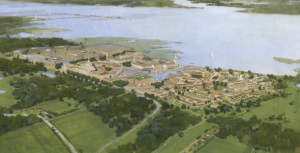
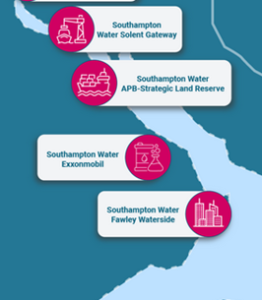
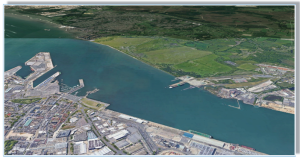
The Solent Freeport itself is a private sector body whose board comprises executive and non-executive members with representatives from the affected local authorities, (including New Forest District Council) and participating landowners (for example Associated British Ports and Exxonmobil). The National Park Authority chair is only an associated member of the board. – an issue we have previously questioned. Given the tax base of their revenues, the board’s investment decisions to boost economic growth are made in consultation HMRC. We have been told that these investment decisions, which could affect the Forest, are to be targeted at projects relating to net-zero, innovation, and skills with a likely focus on the Waterside. The attraction of the Waterside freeport sites to Southampton City Council thus becomes obvious.
One question is how successful is this investment boost likely to be? The projected income from retained business rates alone is £400 million but only over 25 years. There are other big figure projections quoted in the press, but these targets will only be reached as businesses locate to the freeport. The build-up thus is going to be slow. A significant blow is the withdrawal of plans to develop Fawley Waterside which was seen as a high priority development. It is currently being used for commercial storage.
Another high priority site is Solent Gateway and Strategic Land Reserve at Marchwood. The latter is adjacent to the Dibden Bay SSSI, the scene of well-known battles against development. Freeports do not benefit from relaxed planning rules as was feared. However, the Planning and Infrastructure Bill presently before Parliament does severely reduce environmental protections for SSSIs along with other protected sites. [1] Over half the Forest is so protected and thus threatened by these changes. The national environmental charities are outraged by the Bill which even has drawn criticism from the Government’s own watchdog, the Office of Environmental Protection.[2] The NFA has joined the fight by writing to all our local MPs – you could do the same. [3]
The Freeport will also benefit from the proposed widening of the A326 – this is the road that runs down the east side of the Forest from Totton to Fawley. We are watching these £130 million road proposals carefully since the Hampshire County Council plans pay little to no regard to its impact on the Forest whether of the road itself or the consequences for east west traffic across the Forest. The scheme has been quiet recently, probably due to lack of funding, but the moment it raises its head we will be speaking up for the Forest.
This is turning out to be a rather long newsletter – with too many footnotes! There is much more that we could say about the Solent Freeport, and we are planning more detailed report jointly with the Solent Protection Society.
Sarah Nield, Chair New Forest Association
THE COMMONERS’ MONTHLY: JUNE 2025
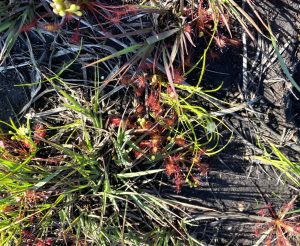
Visiting family from Bristol – my niece her husband and the two children. It is a joy to see them and we went out and did a welfare check on my ponies and an opportunity to pass on knowledge to the next generations. My niece had spent a number of summers here on the farm when she was a teenager and I took her to the drifts and put her to work clearing ragwort and she is encouraging her children to come and spend a summer here. They are city children and it will be good for them to come somewhere quiet and lots of fresh air and my niece and her husband told me some children never leave the city and visit the countryside. On this visit to the Forest, I took the opportunity to stop at a seep and explain there are many interesting different plants here and they looked round for something big until someone looked down and they realise they were all standing on lots of little red plants. They looked round for somewhere else to stand which made me smile as I explained about sundews and pointed out the others under their feet and that these tiny plants would not exist if the Forest was not grazed and kept clear. ‘Book learning’ has its place but experience ‘trumps’ it every time.
Ann Sevier, New Forest Association Council Member
[1] Eg Special Areas of Conservation, Special Protection Areas and Ramsar Sites which fall under the protective regime of Habitat Regulations 2017.
[2] https://www.theoep.org.uk/report/oep-gives-advice-government-planning-and-infrastructure-bill.
[3] A convenient way is through the Hampshire and Isle of Wight trust Campaign see https://www.hiwwt.org.uk/planning-and-infrastructure-bill.
[1] See https://www.advertiserandtimes.co.uk/news/public-to-have-say-on-options-for-councils-revamp-includin-9419977/
[2] https://nationalcharacterareas.co.uk/New-Forest/.
[3] https://newforestassociation.org/wp-content/uploads/2025/05/Back-Up-Land-Report-2025-Jo-Ivey.pdf.
[4] See for example the New Forest National Park’s initiatives at https://www.newforestnpa.gov.uk/conservation/protecting-nature/waterside-green-links/. We welcome the principle although there are aspects of these ideas that required further thought.
[5] See https://newforestassociation.org/notes-solent-freeport-background/
Registered charity no. 260328
New Forest Association © 2026
All rights reserved
All photographs ©
Photographs courtesy: Clive Chatters, Gale Pettifer, Steve Laycock, Mike Read, Brian Tarnoff, Peter Roberts, John Ward.